

 Call
Call Location
Your Weight, Heart, Blood Sugar and Kidneys Are More Connected Than You Think
September 2026
What the New 2026 Cardiovascular-Kidney-Metabolic Guidelines Mean for Your Health
Quick Answer
For years, we have talked about obesity, high blood pressure, cholesterol, diabetes, kidney disease, and heart disease as though they were separate health problems.
Increasingly, we understand that they are not.
In June 2026, the American Heart Association and American College of Cardiology, in collaboration with the American Diabetes Association and American Society of Nephrology, published the first major clinical practice guideline devoted to Cardiovascular-Kidney-Metabolic syndrome, or CKM syndrome. The guideline recognizes that excess or dysfunctional body fat, metabolic problems, kidney disease, and cardiovascular disease are deeply interconnected—and should often be evaluated and treated that way.
This is a major change in how we think about preventive medicine.
Instead of waiting for obesity to become diabetes, diabetes to damage the kidneys, or metabolic disease to contribute to heart disease, CKM medicine asks a better question:
How early can we recognize the physiology moving in the wrong direction—and change its course?
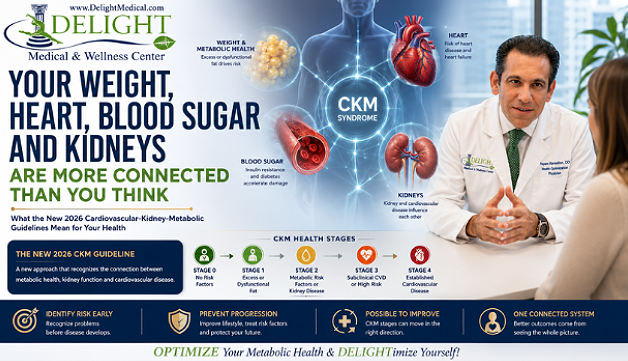
Key Takeaways
- The new 2026 guideline formally recognizes the connection between body fat, blood sugar, blood pressure, cholesterol, kidney health, and cardiovascular disease.
- CKM health is classified along a spectrum from Stage 0 through Stage 4, allowing physicians to identify risk before someone develops obvious cardiovascular disease.
- Excess abdominal or dysfunctional fat can be an early part of the process—not merely a cosmetic issue.
- Kidney health deserves attention much earlier because the kidneys and cardiovascular system continuously influence each other.
- The guideline recommends looking at both 10-year and 30-year cardiovascular risk in appropriate patients using the newer PREVENT risk equations.
- Lifestyle, body composition, weight management, blood pressure, cholesterol, glucose control, and appropriate medications all become parts of one coordinated strategy.
- Perhaps most importantly, CKM stages can potentially move in the right direction through lifestyle changes, weight loss, and appropriate treatment.
“Doctor, Which Number Should I Be Worried About?”
This is a conversation I have with patients all the time.
A patient sits across from me with their laboratory results and starts going down the list.
“My sugar is a little high.”
“My cholesterol isn’t terrible.”
“My blood pressure has been creeping up.”
“My kidney number was slightly different this time.”
“And yes, I’ve gained about 25 pounds.”
Then comes the question:
“Which one should I be worried about?”
My answer is often:
“I don’t want you to worry about any one of them. I want you to understand how they fit together.”
Because the interesting part isn’t necessarily that five different things are going wrong.
Sometimes they’re five different clues pointing toward one underlying physiological process.
And that is essentially what the new CKM guidelines are asking physicians and patients to recognize.
Think of Your Body as a House, Not a Collection of Rooms
Imagine walking through a house and discovering problems in several rooms.
There’s moisture underneath the kitchen sink. Paint is bubbling in the hallway. The bedroom wall feels damp. And there’s mold appearing in the bathroom.
You could hire four different people to repair four different walls.
Or someone could finally crawl underneath the house and discover:
There’s one leaking pipe connecting all of them.
That’s how I want you to think about Cardiovascular-Kidney-Metabolic syndrome.
For decades, medicine understandably developed specialties around individual organs.
- A cardiologist takes care of the heart.
- A nephrologist takes care of the kidneys.
- An endocrinologist treats diabetes.
- An obesity specialist treats excess weight.
- Your primary care physician tries to keep track of everything.
Those specialties remain extremely important.
But your body doesn’t know which specialist treats which organ.
- Your kidneys are talking to your heart.
- Your fat tissue is talking to your liver.
- Your pancreas is responding to your muscles.
- Your blood vessels are responding to your blood pressure, glucose, cholesterol, hormones, inflammation, and metabolic environment.
There aren’t really separate rooms.
There is one house.
And that’s the memorable idea behind CKM syndrome.
What Exactly Is Cardiovascular-Kidney-Metabolic Syndrome?
CKM stands for:
- Cardiovascular — your heart and blood vessels.
- Kidney — your kidneys and their ability to filter blood and regulate important functions.
- Metabolic — factors such as body fat, insulin resistance, blood sugar, blood pressure, and abnormal lipids.
CKM syndrome describes the ways these systems interact and can progressively influence one another.
The 2026 guideline specifically defines CKM as an interconnected condition involving metabolic risk factors—including obesity and type 2 diabetes—chronic kidney disease, and cardiovascular disease. It replaces and substantially expands the older 2013 adult overweight and obesity guideline.
That last point is significant.
We’re no longer talking about obesity simply as:
“You weigh too much. Let’s get the weight down.”
We’re increasingly asking:
What is excess or dysfunctional fat doing to the rest of your physiology?
That is a much better question.
Body Fat Is Not Just Stored Energy
One of the most important changes in our understanding of obesity has been recognizing that fat tissue isn’t simply a storage locker for extra calories.
Fat is biologically active tissue.
And where that fat accumulates matters.
Particularly important is visceral fat—the fat that accumulates deeper inside the abdomen around internal organs.
As fat tissue becomes excessive or dysfunctional, it can contribute to insulin resistance and an unhealthy metabolic environment.
Then a familiar pattern can begin.
- Blood sugar rises.
- Triglycerides rise.
- Blood pressure rises.
- The liver may accumulate fat.
- The pancreas works harder to maintain normal glucose.
- Blood vessels are exposed to increasingly unfavorable conditions.
- Over time, the heart and kidneys can become involved.
This doesn’t happen to every person in exactly the same way.
But it explains why I care about body composition, not simply body weight.
Two people can weigh exactly 200 pounds and have very different amounts of muscle, visceral fat, metabolic health, and cardiovascular risk.
The scale gives us information.
It doesn’t tell us the whole story.
Insulin Resistance Can Be an Early Warning Sign
Before someone develops type 2 diabetes, the body can spend years compensating for insulin resistance.
Insulin is essentially one of the body’s traffic controllers for energy.
After you eat, glucose enters the bloodstream. Insulin helps direct that glucose into cells where it can be used or stored.
When tissues become resistant to insulin, the pancreas initially responds by producing more of it.
For a while, blood sugar may still look relatively normal.
That’s important.
Because a “normal” glucose doesn’t always mean the metabolic system isn’t working harder behind the scenes.
Eventually, compensation may become inadequate.
- Blood sugar rises.
- Prediabetes appears.
- In some people, type 2 diabetes follows.
But CKM thinking encourages us not to wait until the final diagnosis.
The earlier metabolic dysfunction is recognized, the more opportunity we may have to change its trajectory.
Why Are the Kidneys Suddenly Part of This Conversation?
This may be the biggest surprise for many patients.
Most people understand that obesity and diabetes can affect the heart.
Far fewer realize how closely the kidneys and cardiovascular system are connected.
Your kidneys do much more than make urine.
They help regulate fluid balance, blood pressure, electrolytes, hormones, and the chemical environment your cardiovascular system operates within.
And the relationship works both ways.
- High blood pressure can damage the kidneys.
- Diabetes can damage the kidneys.
- Kidney dysfunction can increase cardiovascular risk.
- Heart disease can affect kidney function.
One system begins putting pressure on another, which can then feed back into the original problem.
It can become a physiological loop.
That is why kidney function deserves attention long before someone reaches kidney failure.
The CKM framework specifically incorporates chronic kidney disease into cardiovascular and metabolic risk assessment rather than treating it as a completely separate issue.
The New CKM Stages: Where Are You on the Road?
One of the most useful parts of the new framework is that CKM syndrome is described in stages.
I like this because it changes the conversation from:
“Do I have heart disease—yes or no?”
To:
“Where am I along the road, and can we change direction?”
Stage 0: Protect What You Have
Stage 0 means no CKM risk factors: healthy weight and waist circumference, normal blood pressure, glucose and lipids, normal kidney health, and no evidence of cardiovascular disease.
The goal here is simple:
Stay here.
This is prevention in its purest form.
Stage 1: The Earliest Metabolic Changes
Stage 1 includes excess or dysfunctional fat tissue without the more advanced metabolic, kidney, or cardiovascular problems seen in later stages.
This can include overweight or obesity, abdominal obesity, or prediabetes.
The goal is to intervene before additional problems develop.
The guideline emphasizes lifestyle change and weight management, including medications or metabolic/bariatric surgery when appropriate, and notes that losing at least 5%–10% of body weight can reduce CKM-related risk, with greater benefits often occurring with greater weight loss.
This is exactly why I don’t like waiting until someone develops diabetes before taking metabolic health seriously.
The warning lights may already be on.
Stage 2: Metabolic Risk or Kidney Disease Has Developed
Stage 2 includes conditions such as high blood pressure, high triglycerides, metabolic syndrome, type 2 diabetes, or moderate-to-high-risk chronic kidney disease.
Now the different rooms in our house are beginning to affect each other more clearly.
Lifestyle remains foundational.
But appropriate medical treatment becomes increasingly important.
The goal isn’t merely to make each laboratory number look prettier.
The goal is to reduce the patient’s future cardiovascular and kidney risk.
Stage 3: Disease May Be Developing Before You Feel It
This stage is especially important to me as a prevention-focused physician.
Stage 3 can include subclinical cardiovascular disease—meaning disease that can be detected even though the patient hasn’t necessarily had a heart attack, stroke, or other obvious cardiovascular event.
For example, the guideline includes significant coronary artery calcium as one way of identifying subclinical coronary atherosclerosis. A coronary calcium score of 100 or greater can qualify as a Stage 3 finding in the appropriate CKM setting. Stage 3 can also include evidence of pre-heart failure, very-high-risk kidney disease, or a very high predicted cardiovascular risk.
This is where preventive medicine becomes incredibly powerful.
Because now we can sometimes see tomorrow’s risk today.
And if we can see it, we can do something about it.
Stage 4: Established Cardiovascular Disease
Stage 4 means clinical cardiovascular disease is already present along with CKM risk factors.
That can include coronary heart disease, heart failure, stroke, peripheral artery disease, or atrial fibrillation. The framework further distinguishes whether kidney failure is present.
At this stage, treatment becomes secondary prevention: protecting the patient from additional cardiovascular events while aggressively managing the metabolic and kidney factors contributing to risk.
One of the Most Encouraging Ideas: You May Be Able to Move Backward
When patients hear the word “stage,” they sometimes assume it means an irreversible progression.
Stage 1 becomes Stage 2. Stage 2 becomes Stage 3. Stage 3 becomes Stage 4.
But that is not the goal of this framework.
The guideline specifically discusses preventing progression and promoting regression of CKM stages through lifestyle improvement and weight loss.
That’s a very important distinction.
Imagine seeing a sign on the highway saying:
Bridge out 20 miles ahead.
You don’t continue driving because the bridge hasn’t appeared yet.
You change direction.
That’s what good preventive medicine should do.
We’re Also Getting Better at Measuring Future Risk
Another important part of the guideline is the use of the PREVENT equations.
These newer risk calculators can estimate a person’s 10-year and 30-year risk of cardiovascular disease and incorporate cardiovascular, kidney, and metabolic information.
For appropriate patients in CKM Stages 0 through 3, the guideline recommends using PREVENT to estimate risk for atherosclerotic cardiovascular disease, heart failure, and total cardiovascular disease.
I particularly like the idea of looking beyond 10 years.
If you’re 45 years old, hearing that your chance of having a cardiovascular event over the next decade isn’t extremely high can sound reassuring.
But you’re hopefully not planning to live only ten more years.
What about the next 30?
Preventive medicine should care about the 75-year-old version of you while you’re still 45.
The Goal Isn’t More Testing. It’s Better Understanding.
Whenever a new guideline appears, there’s a temptation to turn it into a checklist of tests.
That’s not the point.
The goal isn’t to order every possible laboratory test and scan on every person.
The goal is to ask better questions.
- What is your blood pressure?
- What is happening with your glucose?
- What does your lipid profile look like?
- How much abdominal or visceral fat are you carrying?
- How is your kidney function?
- Do you have albumin leaking into your urine?
- What is your family history?
- Do you smoke?
- How active are you?
- How is your sleep?
- What does your body composition look like?
- When appropriate, is there evidence of cardiovascular disease developing beneath the surface?
These pieces create a picture.
Health Optimization is about understanding the picture—not chasing one isolated number.
Weight Loss Has Become Much More Than a Cosmetic Conversation
This guideline also arrives at an extraordinary time in obesity medicine.
We now have increasingly effective tools for treating obesity.
- Nutrition.
- Exercise.
- Behavioral strategies.
- Metabolic and bariatric surgery.
- Newer medications, including GLP-1-based therapies, that can produce substantial weight loss in appropriately selected patients.
The CKM guideline incorporates modern obesity treatment into a broader strategy for reducing cardiovascular and kidney risk.
That changes how I want patients to think about losing weight.
The goal isn’t:
“I want to look better at the beach.”
There’s nothing wrong with wanting to look better.
But medically, the more important question is:
“What happens inside my body when I reduce unhealthy fat while preserving muscle?”
- Blood pressure may improve.
- Insulin sensitivity may improve.
- Glucose may improve.
- Triglycerides may improve.
- Sleep apnea may improve.
- Mobility may improve.
- Inflammatory burden may improve.
- Cardiovascular risk may change.
Suddenly, obesity treatment isn’t sitting in its own room anymore.
It’s connected to the entire house.
What This Means for You
You don’t need to memorize the letters CKM.
You don’t need to determine your own CKM stage.
And you certainly don’t need to become your own cardiologist, nephrologist, endocrinologist, and obesity specialist.
The practical lesson is much simpler:
Stop thinking about your health numbers individually.
If your weight is increasing, blood pressure is creeping upward, A1C has entered the prediabetes range, triglycerides are rising, and kidney markers are beginning to change, don’t ask which one matters.
Ask:
“What is the physiology connecting these changes, and what can I do now?”
That question can completely change the direction of your healthcare.
Myth vs. Fact
Myth: Obesity is mainly a cosmetic problem.
Fact: Excess and dysfunctional adipose tissue can contribute to metabolic changes that affect cardiovascular and kidney health. The new CKM framework places excess or dysfunctional adiposity at the beginning of the disease spectrum.
Myth: If my blood sugar isn’t diabetic yet, I don’t have a metabolic problem.
Fact: Prediabetes and insulin resistance can represent earlier metabolic dysfunction. CKM prevention is specifically designed to identify risk before advanced disease develops.
Myth: Kidney disease and heart disease are separate problems.
Fact: Kidney and cardiovascular health are strongly interconnected, which is one reason chronic kidney disease is incorporated directly into CKM staging.
Myth: If I don’t have symptoms, cardiovascular screening doesn’t matter.
Fact: Some patients develop detectable subclinical cardiovascular disease before symptoms occur. Appropriate screening depends on individual age and risk.
Myth: Once I move into a higher CKM stage, nothing can be done.
Fact: The guideline specifically emphasizes preventing progression and, when possible, promoting regression through lifestyle changes, weight management, and appropriate medical treatment.
Frequently Asked Questions
What does CKM stand for?
CKM stands for Cardiovascular-Kidney-Metabolic syndrome. It describes the interconnected relationship between metabolic risk factors, kidney disease, and cardiovascular disease.
Is CKM syndrome a new disease?
The biological connections are not new. What is new is the formal clinical framework that brings these interconnected conditions together for prevention, staging, risk assessment, and treatment.
Why does my waist size matter?
Abdominal fat can provide information about metabolic risk that body weight or BMI alone may miss. The guideline recommends considering waist circumference along with BMI when evaluating adiposity and CKM risk.
What tests evaluate kidney health?
Common evaluation includes a blood test used to estimate kidney filtration, called eGFR, and a urine albumin-to-creatinine ratio, which can identify abnormal protein leakage. Your physician can determine when these tests are appropriate.
What is the PREVENT calculator?
PREVENT is an American Heart Association cardiovascular risk assessment tool that estimates 10-year and 30-year risk and incorporates cardiovascular, kidney, and metabolic health. The new guideline uses PREVENT to help guide CKM risk assessment and treatment decisions.
Does having obesity mean I have heart disease?
No. Obesity is a risk factor, not proof of cardiovascular disease. That’s precisely why staging is useful: it distinguishes earlier metabolic risk from subclinical and established cardiovascular disease.
Can CKM syndrome be improved?
In many patients, yes. Improving body composition, increasing physical activity, improving nutrition, treating blood pressure and abnormal lipids, improving glucose control, stopping smoking, and using appropriate medications can reduce risk and potentially improve CKM stage.
Bottom Line
For years, patients have been handed separate numbers.
- Weight.
- Blood pressure.
- A1C.
- Cholesterol.
- Triglycerides.
- Kidney function.
- Cardiovascular risk.
And understandably, they have wondered:
“Which one matters most?”
The 2026 Cardiovascular-Kidney-Metabolic guideline gives us a better way to answer that question.
They matter together.
Your heart doesn’t live independently from your kidneys.
Your kidneys don’t live independently from your blood pressure.
Your blood pressure doesn’t live independently from your metabolic health.
And your metabolic health isn’t independent of your body composition, activity, nutrition, sleep, genetics, and environment.
Remember our house?
If several rooms keep developing problems, don’t spend the next 20 years repainting the walls.
Find the pipe.
Understand the underlying physiology.
Then intervene early enough to change where that physiology is taking you.
That, to me, is the real significance of CKM medicine.
And it’s also the future of prevention.
The Delight Difference
At Delight Medical & Wellness Center, this interconnected approach to health is central to how we practice Health Optimization Medicine.
We don’t want to look at your weight on Monday, cholesterol on Tuesday, blood sugar on Wednesday, and cardiovascular risk five years later as though they have nothing to do with one another.
We look at the patient as a whole.
That may include body composition, visceral fat, metabolic health, blood pressure, advanced lipid evaluation when appropriate, glucose regulation, kidney health, cardiovascular risk, hormonal health, sleep, nutrition, exercise, and long-term quality of life.
Because the goal isn’t simply to prevent one diagnosis.
The goal is to help you remain metabolically healthy, cardiovascularly healthy, mobile, strong, energetic, and independent for as much of your life as possible.
About Dr. Payam Kerendian
Dr. Payam Kerendian, DO, is the founder of Delight Medical & Wellness Center in Los Angeles, California.
His practice focuses on Health Optimization Medicine, including obesity and metabolic health, cardiovascular risk reduction, body composition, hormone optimization, preventive medicine, and healthy aging.
For more than two decades, Dr. Kerendian has helped patients better understand the physiology behind their health so they can make informed decisions before small problems become larger ones.
His philosophy is simple:
Understand your physiology. Optimize your health. Improve your quality of life.
Ready to Understand the Bigger Picture of Your Health?
If you’ve been told that your blood pressure is “a little high,” your glucose is “borderline,” your cholesterol needs watching, or that losing some abdominal fat would probably help, those findings shouldn’t necessarily be viewed as unrelated problems.
They may be pieces of the same physiological story.
A comprehensive Health Optimization evaluation can help put those pieces together, identify where your risks are developing, and create a personalized strategy for improving your metabolic and cardiovascular health.
Because you don’t have five different bodies requiring five different plans.
You have one body—and everything is connected.