

 Call
Call Location
When Your Body Whispers Before It Screams
July 2026
What the Recent Passing of Senator Lindsey Graham Can Teach Us About Silent Cardiovascular Disease
Sometimes the greatest threat to our health isn’t what we feel—it’s what we don’t.
Quick Answer
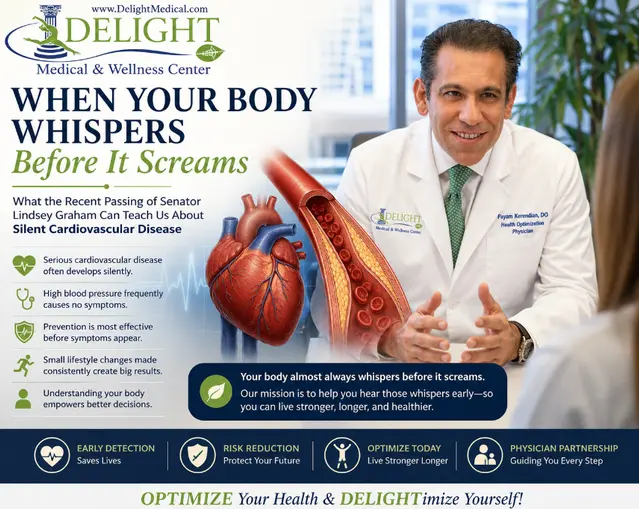
Silent cardiovascular disease refers to conditions that develop gradually, often without causing noticeable symptoms until they become serious or even life-threatening. High blood pressure, elevated cholesterol, diabetes, obesity, smoking, family history, and aging can all quietly damage the heart and blood vessels over many years. One uncommon but devastating condition, an aortic dissection, occurs when a tear develops in the wall of the body’s largest artery. Although not every cardiovascular emergency can be prevented, identifying and optimizing risk factors early can significantly reduce future risk. Health Optimization focuses on recognizing these subtle warning signs—the body’s “whispers”—long before they become emergencies, helping patients preserve their health, energy, mobility, and quality of life.
Key Takeaways
- Serious cardiovascular disease often develops silently over many years.
- High blood pressure frequently causes no symptoms while damaging arteries.
- An aortic dissection is uncommon but is a true medical emergency.
- Feeling healthy does not always mean your cardiovascular system is healthy.
- Prevention is most effective before symptoms appear.
- Small lifestyle changes made consistently often produce the greatest long-term health benefits.
- Understanding your body’s physiology empowers better healthcare decisions.
The Body Rarely Surprises Us… It Usually Warns Us First
One of the questions I hear most often from patients is surprisingly simple.
“Doctor… if something serious were happening inside my body, wouldn’t I know?”
It’s an understandable question. Most of us grow up believing that pain is our body’s alarm system. If something is wrong, surely it will hurt. If our heart is in danger, we’ll have chest pain. If an artery is becoming damaged, we’ll feel it. And if a life-threatening condition is developing, our body will certainly wave a giant red flag.
Unfortunately, the human body doesn’t always work that way.
The recent passing of Senator Lindsey Graham has led many people to ask how someone can appear active and engaged one day and suffer a catastrophic cardiovascular event the next. Regardless of politics, moments like these remind us that the body often tells a story long before anyone realizes they’re reading it. As physicians, we never want tragedy to become entertainment. We hope it becomes education. If a heartbreaking event encourages someone to finally check their blood pressure, schedule a long-overdue physical, or simply become more curious about their own health, then perhaps some good can emerge from an otherwise painful loss.
One phrase I often tell my patients has become one of my favorite reminders:
Your body almost always whispers before it screams.
The challenge isn’t that those whispers don’t exist. The challenge is that they’re usually quiet, gradual, and easy to ignore while life keeps us busy.
Why Feeling Fine Can Be Misleading
Imagine you own a beautiful home.
Every morning you wake up, make coffee, and head off to work. The lights turn on, the faucets run, and everything seems perfectly normal. Unknown to you, however, a tiny leak has developed behind one of the walls. It’s only a few drops at a time, so there’s no puddle on the floor and no obvious damage. Weeks become months. Months become years. Slowly, moisture weakens the wooden support beams hidden behind the drywall.
Then one morning, part of the ceiling suddenly collapses.
Most people would describe that as an unexpected event.
But was it really?
The collapse wasn’t the beginning of the problem. It was simply the first visible sign that the problem had been quietly progressing for a long time.
Our cardiovascular system behaves in much the same way.
Heart disease rarely begins on the day someone has a heart attack. A stroke usually isn’t the first chapter of the story. Even certain conditions affecting the body’s largest blood vessels often develop silently over years before producing symptoms that finally demand our attention.
The body is remarkably resilient. It compensates. It adapts. It works overtime to keep us functioning despite the gradual changes taking place beneath the surface. That’s one of its greatest strengths—but it can also become one of its greatest disguises.
What Is Silent Cardiovascular Disease?
When people hear the phrase heart disease, many immediately picture someone clutching their chest in pain. In reality, cardiovascular disease is much broader than that image. It includes a wide range of conditions affecting the heart and blood vessels, many of which progress slowly and quietly before causing noticeable symptoms.
High blood pressure is one of the best examples. Millions of people live with hypertension for years without realizing it because it usually doesn’t hurt. Elevated cholesterol quietly contributes to plaque formation without making you feel tired or sick. Blood sugar can remain elevated long before diabetes causes obvious complications. Even changes in the walls of major arteries may develop without producing any warning signs at all.
This is one of the reasons preventive medicine is so valuable. Waiting until symptoms appear is a bit like waiting until smoke fills your kitchen before checking whether the oven is on. By the time the signs become obvious, the process has often been underway for much longer than anyone realized.
Health Optimization takes advantage of something incredibly encouraging: these conditions usually develop over time. That means we often have an opportunity to identify them, understand them, and improve them before they become emergencies.
Why High Blood Pressure Deserves More Respect Than It Gets
If I could convince every adult to pay attention to just one number, it would probably be their blood pressure.
Patients are often surprised when I tell them that hypertension has earned the nickname “the silent killer.” Not because it always leads to tragedy, but because it quietly places additional mechanical stress on the cardiovascular system every hour of every day while producing little or no discomfort.
Think of your home’s plumbing system. The pipes are designed to handle a certain amount of water pressure. If that pressure increases slightly for a few minutes, nothing significant happens. But imagine increasing that pressure every minute of every day for the next twenty years. Eventually, the plumbing begins to experience wear that it was never designed to withstand.
Your arteries are far more sophisticated than plumbing, but the concept is remarkably similar.
Every heartbeat sends blood through your blood vessels under pressure. That’s normal. It’s how oxygen and nutrients reach every organ in your body. However, when that pressure remains elevated year after year, the walls of those arteries experience more stress than they were designed to handle. Fortunately, your body has extraordinary repair mechanisms constantly working to maintain healthy blood vessels. The challenge arises when the damage consistently outpaces the body’s ability to repair itself.
This gradual process doesn’t happen overnight. It unfolds quietly over years, which is exactly why early detection matters so much.
The Body’s Largest Highway
To understand why physicians pay so much attention to the aorta, it helps to picture your circulatory system as an interstate highway network.
Your heart is the central transportation hub, pumping oxygen-rich blood to every corner of your body. The aorta is the largest highway leaving that hub. Every major destination—your brain, kidneys, liver, muscles, and legs—depends on blood traveling safely through this remarkable vessel before branching into smaller roads.
The wall of the aorta is built to withstand incredible force. With every heartbeat, it stretches slightly and recoils, helping maintain smooth blood flow throughout the body. It’s an elegant piece of biological engineering.
Yet even remarkable engineering has limits. Long-standing high blood pressure, certain inherited connective tissue disorders, age-related changes, and other factors can gradually weaken portions of the vessel wall. In some cases, the aorta may enlarge over time. In others, a tear can develop within its inner lining, allowing blood to travel between the layers of the vessel wall. This condition is known as an aortic dissection, and it requires immediate emergency medical care.
Fortunately, aortic dissections remain relatively uncommon. The purpose of understanding them isn’t to create fear. It’s to appreciate why taking care of our cardiovascular health long before an emergency ever occurs is one of the most valuable investments we can make in our future.
Why Health Optimization Begins Before Disease
One of the biggest misconceptions about preventive medicine is that it’s simply about ordering more tests or catching diseases earlier. While screening certainly has its place, that’s not really how I view Health Optimization.
I often explain to patients that traditional medicine and Health Optimization are not competing philosophies—they’re complementary. Traditional medicine is exceptional at diagnosing and treating disease once it becomes apparent. If someone is having a heart attack, a stroke, or an aortic dissection, I want them surrounded by emergency physicians, cardiologists, surgeons, and intensive care specialists. Modern medicine saves lives every day, and we should never lose sight of how remarkable those advances truly are.
Health Optimization simply begins earlier in the story.
Imagine buying a new luxury car. You wouldn’t wait for the engine to seize before changing the oil or replacing worn tires. You maintain it because you want it to perform well for years to come. The same principle applies to our bodies. Rather than waiting for the “check engine” light to illuminate, we periodically lift the hood, evaluate how everything is functioning, and make adjustments while small issues are still manageable.
That’s why I spend so much time discussing physiology with my patients. Understanding why something is happening often makes it much easier to understand what we should do about it. When people understand how blood pressure affects the arteries, how insulin resistance influences metabolism, or how excess visceral fat contributes to inflammation, healthier decisions begin to make more sense. Knowledge transforms motivation into action.
The goal isn’t simply to avoid disease. It’s to preserve energy, mobility, independence, cognitive function, and quality of life for as many years as possible.
What This Means for You
If you were sitting across from me in my office today, here’s what I’d tell you.
Don’t let a tragic news story convince you that cardiovascular disease is unpredictable or inevitable. Instead, let it remind you that many of the conditions leading to serious cardiovascular events develop gradually, giving us an opportunity to intervene long before they become emergencies.
Start with the basics. Know your blood pressure instead of guessing. Understand your cholesterol profile, blood sugar, and body composition. If you smoke, make quitting one of your highest priorities. Move your body regularly with a combination of cardiovascular exercise and resistance training. Prioritize sleep. Eat in a way that supports your metabolism rather than simply satisfying your appetite. And if you have a family history of cardiovascular disease, discuss with your physician whether additional testing or earlier screening makes sense for you.
None of these recommendations are dramatic. That’s precisely the point. Most life-changing improvements in health aren’t the result of one extraordinary decision. They’re the result of many ordinary decisions repeated consistently over months and years.
Your future cardiovascular health is being shaped by the choices you make today—even if you don’t feel the results immediately.
Myth vs. Fact
- Myth: If I feel healthy, my heart and arteries must be healthy. Fact: Many cardiovascular conditions—including high blood pressure and early plaque buildup—can progress for years without causing noticeable symptoms.
- Myth: High blood pressure always causes headaches or dizziness. Fact: Most people with hypertension feel completely normal, which is why routine blood pressure monitoring is so important.
- Myth: Heart disease happens suddenly. Fact: Most cardiovascular disease develops gradually over many years before eventually producing symptoms or complications.
- Myth: Prevention begins when I reach retirement age. Fact: The healthiest arteries at age seventy are usually the result of good habits developed decades earlier.
Frequently Asked Questions
Can you have serious heart disease without symptoms?
Yes. Many forms of cardiovascular disease progress silently for years before producing noticeable symptoms. That’s why preventive evaluations are so valuable.
Why is high blood pressure called the “silent killer”?
Because it usually doesn’t cause pain or obvious symptoms while gradually increasing stress on the arteries, heart, kidneys, and brain over time.
What is an aortic dissection?
An aortic dissection is a medical emergency in which a tear develops within the inner layer of the aorta, allowing blood to separate the layers of the vessel wall. Although uncommon, it requires immediate medical attention.
Can an aortic dissection be prevented?
Not every case can be prevented, particularly when inherited conditions are involved. However, controlling blood pressure, avoiding tobacco, maintaining a healthy lifestyle, and receiving appropriate medical care can reduce risk for many people.
Who should consider cardiovascular screening?
The answer depends on factors such as age, family history, blood pressure, cholesterol levels, diabetes, smoking history, body composition, and other individual risk factors. Your physician can help determine what screening is appropriate for you.
Bottom Line
One of the greatest misconceptions in medicine is that serious disease always announces itself loudly. More often, the body begins with whispers—subtle physiological changes that quietly develop over years before finally demanding our attention. High blood pressure, cholesterol abnormalities, insulin resistance, and many other cardiovascular risk factors rarely cause symptoms early on, but that doesn’t mean they aren’t important.
The encouraging news is that our bodies also possess an extraordinary ability to respond positively when we give them the right environment. Better nutrition, regular physical activity, healthy sleep, stress management, appropriate medical care, and physician-guided prevention can significantly influence our long-term health. We cannot control every medical event, but we can control many of the factors that shape our future.
Health Optimization is about recognizing those whispers, understanding what they mean, and taking thoughtful action before they ever become screams.
The Delight Difference
At Delight Medical & Wellness Center, we believe healthcare should be more than treating disease after it appears. Our mission is to help patients understand their physiology, identify opportunities for optimization, and develop personalized strategies that support long-term health, energy, mobility, and longevity. By combining evidence-based medicine with comprehensive preventive care, we strive to build lasting partnerships that empower patients to take an active role in their health for years to come.
About Dr. Payam Kerendian
Dr. Payam Kerendian, DO, is the founder of Delight Medical & Wellness Center in Los Angeles, California. As a Health Optimization Physician, he focuses on obesity medicine, preventive cardiovascular health, hormone optimization, metabolic wellness, longevity medicine, musculoskeletal care, and helping patients understand the physiology behind their health. His practice is trusted by police and fire first responders, entertainment professionals, healthcare workers, business leaders, and patients from many other professions throughout Southern California. Dr. Kerendian has received recognition from multiple organizations for his expertise, innovation, and commitment to patient-centered care.